I would like some assistance understanding dry brushing and paint washing.
I understand how to do the techniques individually but can you use both techniques at the same time?
I can grasp the idea of painting then dry brushing or painting then washing but I read an article that discussed painting then washing then dry brushing.
If you have used both techniques on a mini, could you describe the colors you used in the process.
swo_daddy was kind enough to tell me his paint color scheme.
Can you do this with both water and oil based paint?
Painting help
Moderators: Albiegamer, mjwest
-
wedge_hammersteel
- Commander
- Posts: 578
- Joined: Sat Sep 27, 2008 12:42 am
- Location: Lafayette, LA

99.9% of my minis are both washed and drybrushed.
Washing provides depth, as does drybrushing. Both combined give even greater depth. Something very important to a small scale (1:3788) miniature.
It's funny you asked this today. On a yahoo group I am a member of, a question was asked about painting klingon minis nad my response included both washing and dry brushing.
I typically think of Klingons as flying Panzer Grey tanks... err, ships. Unfortunately, I felt the Panzer Grey was too close in color to the Gorn ships I use (which are Slate Grey, a fairly dark grey). My Romulans are Ghost Grey, so I also couldn't go too light a grey.
Washing provides depth, as does drybrushing. Both combined give even greater depth. Something very important to a small scale (1:3788) miniature.
It's funny you asked this today. On a yahoo group I am a member of, a question was asked about painting klingon minis nad my response included both washing and dry brushing.
I typically think of Klingons as flying Panzer Grey tanks... err, ships. Unfortunately, I felt the Panzer Grey was too close in color to the Gorn ships I use (which are Slate Grey, a fairly dark grey). My Romulans are Ghost Grey, so I also couldn't go too light a grey.
- 1) I selected Pewter Grey, which is a medium grey color. This is airbrushed onto about 20 or 25 minis at a time.
2) Once the Pewter grey is dry, I wash the minis with Panzer Grey wash. [My was is a mixture of paint and Magic Wash (Magic Wash is a 6:1 mixture of distilled water and Future floor polish. It really reduces the surface tension of the paint and allows it to flow amazingly thin)]
3) After the wash is completely dry, I dry brush. The first drybrush is done with Pewter Grey to restore some of the original medium grey color. 4)A second drybrushing is done with a slightly lighter grey (I think I use Dove Grey, but as I'm at work - I'm not 100% certain).
5) Sometimes, if I'm working on a particularly large piece [C8, B-10], I will do a third drybrush... very, very, very lightly - using Ghost Grey.
After the dry-brushing is complete, I spray it will a thin coat of matte sealent to protect the drybrushing while I detail it out.
Commander, Battlegroup Murfreesboro
Department Head, ACTASF
Department Head, ACTASF
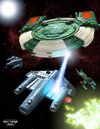
Yeah, it's easy to use both techniques on a mini. The wash settles into the crevices on the mini, making them darker and giving the illusion of depth. The drybrushing hits the raised points, making them lighter and giving the illusion of height (reflected light). Used together, they fool the viewer's eye into seeing something more "3-D" than it is.
I have used this with acrylics (water based) paints, and it works. Oils, I don't know.
I like a more blue-grey on my Klingons, but I can't tell you what I used. Might have been GW Space Wolves grey.
I have used this with acrylics (water based) paints, and it works. Oils, I don't know.
I like a more blue-grey on my Klingons, but I can't tell you what I used. Might have been GW Space Wolves grey.
"Captain" Terry O'Carroll, fourteen papers published including six best of issue
"Man, Terry, you are like a loophole seeking missle!" - Mike West

"Man, Terry, you are like a loophole seeking missle!" - Mike West